In my last post, I talked about the idea of doing lots of aerobic-paced training and a smaller volume of high-intensity training, which I think of as “superpolarized”. I tried it out today which was scheduled to be a harder day. It was enjoyable, first a long pleasant cruise, then finishing up with some strength training and brisk-paced intervals. It’s good to know that science supports this being a healthy way of training because it seems to be something I can readily keep up, especially since there are easier recovery days in between.
Early in the morning, and the marine layer is starting to move in, just hiding the peak of El Toro
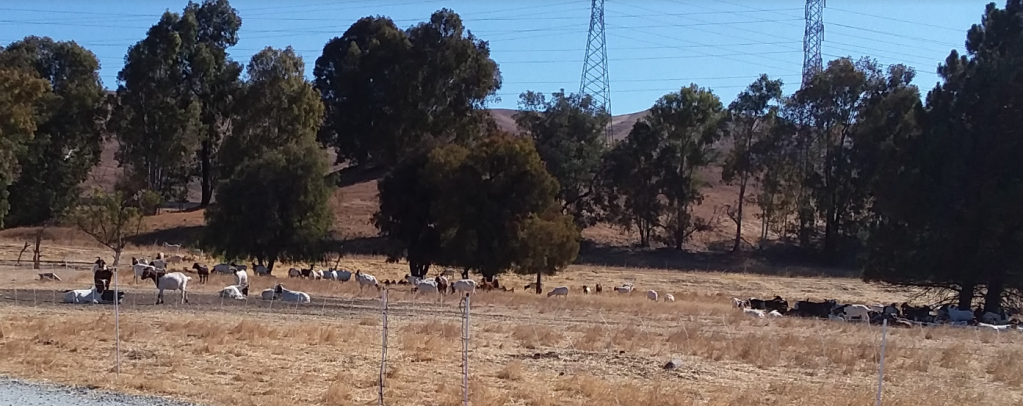
Later in the day, the goats are performing their “organic mowing” service next to the Coyote Creek Trail
https://ift.tt/aS2nC3F Fall in our area is not as spectacular as in other places but it’s nice that it lasts this long. Some trees have lost their leaves by now, but other species, such as maples, are peaking. Yesterday I enjoyed a long ride up into the hills West of town. I rode through Paradise valley then past Chesbro reservoir, and returned to town via Willow Springs road, enjoying the glorious sunshine. Long rides at an easy pace, like this one, feel like they are good for my leaky heart valve, or at least are relaxing. I won’t give them up unless my cardiologist convinces me too, but I’m pretty sure he’ll approve. The hill across Chesbro reservoir, with the dam on the left Looking down Willow Springs road Japanese Maple in our back yard
https://ift.tt/wxOr4u3 My last strength workout went really well, I was able to go pretty hard without pushing my heart rate excessively. But afterwards it occurred to me that monitoring heart rate might not be enough. Strength training can cause a temporary spike in blood pressure which is probably not a good idea. I figured there must be a lot of research on this, because there are a lot of older people with cardiac limitations besides mine which is relatively rare (including heart-attack survivors, angina sufferers, and those with valve regurgitation). And they are still encouraged to do strength training to prevent sarcopenia. So I asked Gemini deep research about it and it produced this fascinating report . It points out that a resistance training session, properly performed, is beneficial to the heart because while it temporarily raises blood pressure, there is “a phenomenon known as post-exercise hypotension, where blood pressure remains below pre-exercise resting levels for se...
https://ift.tt/V59Jb1v A recent article in Neuroscience News covers a Stanford study [1] on cell secretions during exercise. These were previously known about but it was not possible to isolate them from the blood for study. The Stanford group came up with a novel way to dive deeper into the blood to isolate these molecules, called exerkines. The study was on mice and had some surprising results. One was the high number of exerkines produced during exercise. “This means that the effects of physical activity are very widespread across many tissues and organ systems,” one of the co-authors of the study said. “We’re only just starting to understand that complexity.” A second surprise was some unexpected healthy changes (anti-obesity, anti-diabetic, and exercise performance-enhancing) related to liver cells. This new approach is promising and I’m interested in seeing it repeated in humans. References Wei, W, et al, “Organism-wide, cell-type-specific secretome mapping of exercise tr...



Comments
Post a Comment